
 by
by 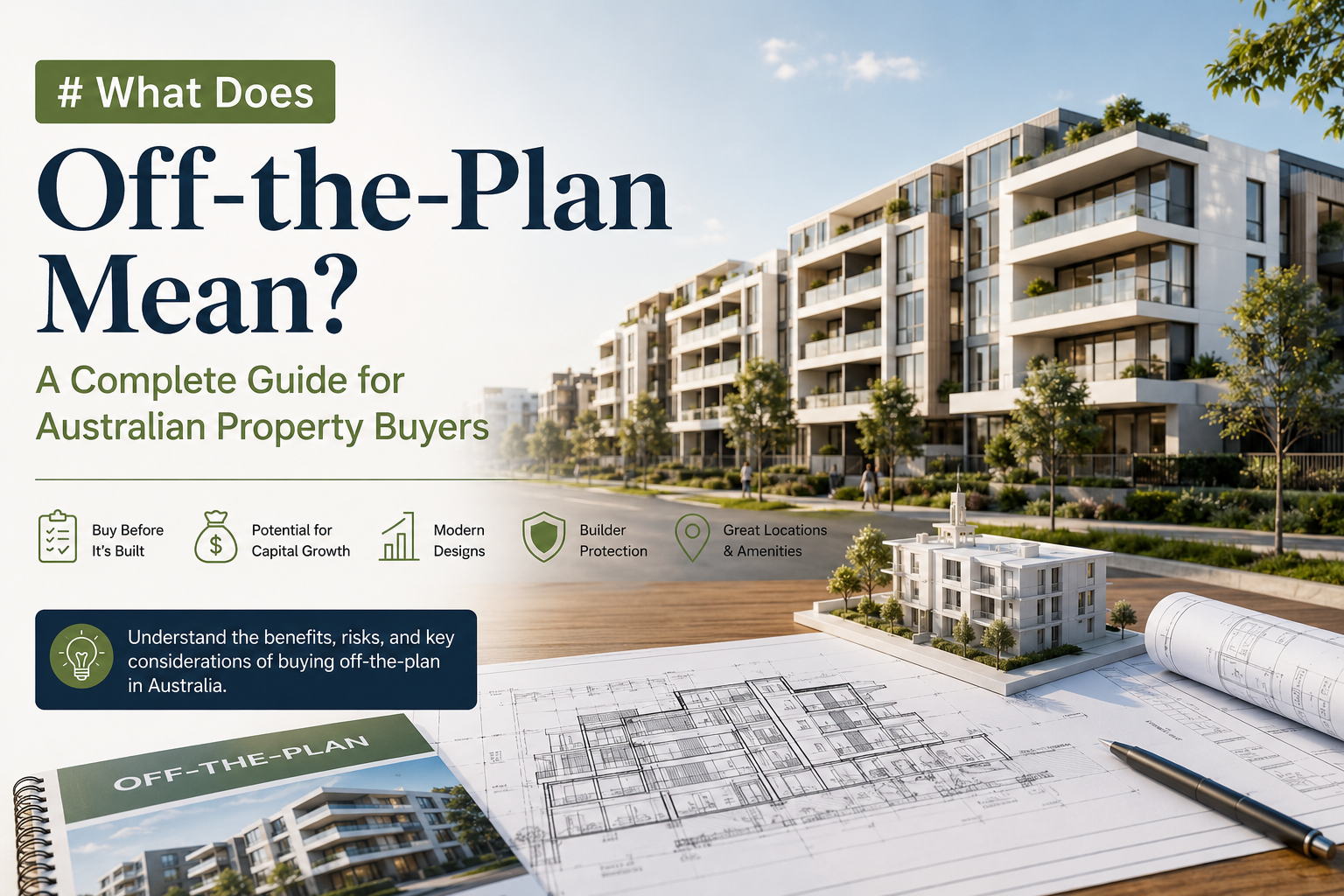
Off-the-plan means buying a property before it has been built, based on architectural plans, floor layouts and display suite finishes rather than a finished, walk-through home. The buyer signs a contract early in the development process and settles once construction is complete and the title is registered, sometimes years later. It’s a common way to buy apartments, townhouses and house-and-land packages across Australia.
What Off-the-Plan Means in Australia
If you’ve searched “what does off the plan mean” or “off the plan meaning”, you’re really asking one thing: how can someone buy a home that doesn’t exist yet? The answer is that an off-the-plan property is sold using architectural drawings, floor plans, a schedule of finishes, and often a scale model or display suite, rather than a completed dwelling you can inspect room by room.
This is different from buying an established property, where you walk through the actual house or flat, see the actual fixtures, and settle within a matter of weeks. With off the plan property, there’s a gap — sometimes a considerable one — between signing the contract and being handed the keys.
Off-the-plan sales are most common with:
- High-rise and mid-rise apartment developments
- Townhouse complexes
- House-and-land packages in new residential estates
Developers use off-the-plan sales to secure buyers and demonstrate demand early, which in turn helps them satisfy lender pre-sale requirements before construction finance is approved.
A Simple Example
Imagine a developer plans a twelve-storey apartment building. Before a single brick is laid, they release floor plans for each apartment, along with a schedule showing the flooring, benchtops, cabinetry and fittings that will be installed. A buyer chooses a particular apartment — say, a two-bedroom unit on the eighth floor — signs a contract and pays a deposit. Construction then begins. Roughly eighteen months to three years later, once the building is complete and the strata title is registered, the buyer settles and takes possession of the finished apartment.
This is the essence of buying off the plan: you’re purchasing a promise, backed by a legally binding contract, rather than a finished product.
How Does Buying Off-the-Plan Work? Step by Step
Understanding how does buying off the plan work is easier when broken into stages:
- Research and selection — You choose a development, review the plans, finishes schedule and disclosure statement, and select a specific lot or apartment.
- Contract of sale — You (usually through a solicitor or conveyancer) review and sign the contract. This document sets out the purchase terms, sunset date, variation clauses and inclusions.
- Cooling-off period — Depending on the state or territory, a short cooling-off period may apply, during which you can withdraw, though this varies and doesn’t apply uniformly across Australia.
- Deposit payment — A deposit is paid upon exchange of contracts, often held in a trust account or as a bank guarantee/deposit bond rather than cash.
- Finance arrangement — Buyers typically arrange conditional finance approval before signing, then finalise unconditional approval closer to completion.
- Construction period — The developer builds the project. Buyers usually receive periodic updates but have no right to alter the build once contracted.
- Practical completion — The building or dwelling is finished, and occupation certificates and title registration are processed.
- Pre-settlement inspection — Buyers typically get the chance to inspect the finished property and note any defects before settlement.
- Settlement — The balance of the purchase price is paid, the title transfers, and the buyer takes possession.
When Is the Deposit Paid?
Deposits on off-the-plan contracts are generally paid at the time contracts are exchanged, rather than at settlement. The exact deposit amount varies by developer, state and project, so it’s important to check the specific contract rather than assume a standard figure. Many contracts allow the deposit to be paid via a deposit bond or bank guarantee instead of cash, which can help buyers avoid tying up funds for the full construction period. The remainder of the purchase price is then paid at settlement, once the property is complete and title has issued.
What Happens During Construction?
Once contracts are exchanged, the buyer largely steps back and the developer takes over. During this period:
- The buyer’s deposit is generally held in trust and cannot be accessed by the developer until settlement.
- Buyers should keep finance pre-approval current, since lenders may require updated documentation as completion approaches.
- Developers may issue variation notices if minor changes to specifications or the building design occur — most contracts allow for “reasonable” variations.
- Construction delays are common and are usually addressed through a sunset clause in the contract, which sets an outer date by which the project must be completed.
- Buyers have little ability to inspect the property in person during this stage, beyond any display suite or occasional progress updates offered by the developer.
What Happens at Settlement?
Settlement is the final stage of an off-the-plan purchase. It occurs once:
- The building has received its occupation certificate (or equivalent),
- The strata or title plan has been registered, and
- The property is ready for the buyer to take possession.
At this point, the buyer (usually via their conveyancer or solicitor) organises final finance drawdown, pays the outstanding balance, and the title transfers into the buyer’s name. Before this happens, most buyers undertake a pre-settlement inspection to check the finished property matches the contract and note any defects for the developer to rectify, either before or shortly after settlement.
Apartments vs Townhouses vs House-and-Land
Off-the-plan purchases span several property types, and the process differs slightly for each:
Apartments are the most common form of off-the-plan purchase, particularly in inner-city and middle-ring suburbs. Buyers select a unit within a larger building, and settlement is tied to the completion of the whole development and strata registration.
Townhouses work similarly, though they’re often part of smaller, multi-dwelling developments. Buyers may have slightly more visibility into individual build progress than in a large tower.
House-and-land packages involve purchasing a vacant block and a home design as two linked contracts — one for the land, one for the build. Settlement on the land can occur before construction of the house begins, meaning buyers may hold vacant land while the home is built, which has different tax and finance implications compared to buying a completed apartment.
Advantages of Buying Off-the-Plan
- Brand-new dwelling — Everything is new, from fixtures to fittings, generally covered by statutory builder’s warranties.
- Time to save and arrange finance — The gap between contract and settlement gives buyers time to save additional funds or get finances in order.
- Choice of position and finishes — Early buyers often get first pick of floor level, aspect, and sometimes finish options.
- Depreciation benefits for investors — New properties typically offer stronger depreciation schedules than established stock, which can be relevant for investment buyers (though tax outcomes depend on individual circumstances).
- Concessions and incentives — Various stamp duty concessions or grants may apply to new or off-the-plan property depending on the state and the buyer’s circumstances, though these rules vary and change over time, so buyers should check current entitlements with their state revenue office.
Risks of Buying Off-the-Plan
- Construction delays — Projects can run well beyond the anticipated completion date, sometimes stretching into years.
- Sunset clause risk — In some cases, developers have used sunset clauses to rescind and resell contracts if a project overruns, an issue several states have moved to restrict.
- Market movement — Property values or the buyer’s financial circumstances can change materially between signing and settlement.
- Valuation shortfall — A bank valuation at settlement can come in lower than the contracted purchase price, affecting how much the lender is willing to finance.
- Finished product variance — What’s delivered can differ from marketing materials, floor plans, or display suites, within the bounds the contract allows.
- Developer risk — Not all developers complete every project; buyer protections vary depending on how the deposit is held and the project’s financial structure.
What Should Buyers Check Before Signing?
Before signing an off-the-plan contract, it’s worth checking:
- The sunset date and what happens if it passes
- How and where the deposit is held
- What variations the developer is permitted to make without buyer consent
- The disclosure statement and finishes schedule in detail
- Whether a cooling-off period applies and its length
- The developer’s track record on previous projects
- Body corporate or strata levy estimates, where relevant
- Finance pre-approval conditions and how they might be affected by a long settlement period
- Whether foreign investment approval is required, if applicable to the buyer’s residency status
Because off-the-plan contracts are legally binding and often harder to exit than contracts for established property, most buyers engage a solicitor or conveyancer experienced in off-the-plan purchases before signing.
Learn More
This article answers the core question of what off-the-plan means. For a deeper, step-by-step walkthrough covering contracts, finance, sunset clauses, defects, settlement and everything else involved in the process, see our full guide: The Complete Guide to Buying Off-the-Plan Property in Australia (2026 Edition).
Frequently Asked Questions
1. What does buying off-the-plan mean? Buying off-the-plan means signing a contract to purchase a property — usually an apartment, townhouse or house-and-land package — before it has been built, based on plans, drawings and a schedule of finishes rather than a completed dwelling.
2. How does buying off-the-plan work in Australia? A buyer selects a property from plans, signs a contract, pays a deposit, and then waits while the developer completes construction. Settlement occurs once the building is finished, the occupation certificate is issued and title is registered.
3. How much deposit do you need to buy off-the-plan? Deposit amounts vary by developer, project and state, so there’s no single figure. Deposits can often be paid as cash, a bank guarantee or a deposit bond — buyers should check the specific contract terms.
4. When do you pay for an off-the-plan property? The deposit is generally paid on exchange of contracts, and the remaining balance is paid at settlement, once the property is complete and title has issued.
5. Do you need finance approval before buying off-the-plan? Most buyers arrange conditional finance approval before signing, then confirm unconditional approval closer to settlement, since lenders typically require updated documentation nearer completion.
6. How long does an off-the-plan property take to complete? Timeframes vary significantly by project size and type, ranging from roughly a year for smaller townhouse developments to several years for large apartment towers.
7. What happens if construction is delayed? Most contracts include a sunset clause setting an outer date for completion. If the project runs beyond this date, buyers may have rights to terminate, though the specific terms differ by contract and state.
8. Can the price change after signing an off-the-plan contract? The purchase price is generally fixed once contracts are signed, though variation clauses may allow the developer to make minor changes to specifications, finishes or the final building design within agreed limits.
9. Can you sell an off-the-plan property before settlement? It depends on the contract. Some contracts permit assignment or nomination of the purchase to another buyer before settlement, while others restrict or prohibit this — check the specific terms before assuming it’s possible.
10. What happens if the bank valuation is lower than the purchase price? If a lender’s valuation at settlement comes in below the contracted price, the buyer may need to cover the shortfall with additional funds, renegotiate finance, or in some cases seek to exit the contract, depending on its terms.
11. Is buying off-the-plan cheaper than buying an established property? Not necessarily. Off-the-plan properties may attract certain stamp duty concessions or incentives in some states, but overall cost depends on the specific project, market conditions and location rather than the purchase method alone.
12. Can first-home buyers buy off-the-plan? Yes. Off-the-plan properties are a common option for first-home buyers, and some state-based grants or concessions are specifically linked to new or off-the-plan dwellings, though eligibility rules vary and should be checked with the relevant state authority.
13. Can investors buy off-the-plan property? Yes. Investors often buy off-the-plan for depreciation benefits and to secure new stock, though they take on the same construction and settlement risks as owner-occupier buyers.
14. Can foreign buyers purchase off-the-plan property in Australia? Generally yes, subject to approval. Off-the-plan and other new dwellings are typically the property types foreign buyers are permitted to purchase, subject to Foreign Investment Review Board (FIRB) approval and any applicable state-based surcharges, which buyers should confirm are current before proceeding.
15. What should you check before buying off-the-plan? Key checks include the sunset date, how the deposit is held, permitted variations, the disclosure statement and finishes schedule, cooling-off arrangements, the developer’s track record, and finance pre-approval conditions — ideally reviewed with a solicitor or conveyancer experienced in off-the-plan contracts.
Buying property is a significant step, but it doesn’t have to be complicated. With the right preparation and support, you can navigate the Australian real estate marketplace with clarity and confidence.
Disclaimer
The content published on this blog is provided by New Squares for general information purposes only. Although every effort is made to ensure the accuracy, currency, and reliability of the information at the time of publication, New Squares makes no representations or warranties, express or implied, regarding the completeness, accuracy, suitability, or availability of any information contained herein. All content is subject to change without notice. Nothing in this blog constitutes financial, legal, investment, or professional advice. Readers must not rely solely on the information provided and should obtain independent professional advice before making any property, investment, or financial decisions. To the fullest extent permitted by law, New Squares, its directors, employees, agents, and contributors disclaim all liability for any loss, damage, or consequences arising from the use of, or reliance on, any information contained in this blog. New Squares does not accept responsibility for the content, accuracy, or availability of any external websites linked within this blog, and inclusion of such links does not imply endorsement. By accessing this blog, you acknowledge and agree to these terms.


Join The Discussion